Sunday, February 24, 2013

Life On Board Ship


Life on board ship is a fun adventure in itself.  The Flamingo I has four decks.  The main deck has the crew quarters, a kitchen, a large dining area and a lounge.  The lower deck, which is below water level, has several guest cabins in the front half of the boat; this is where our cabins are located. The upper deck includes the bridge at the front, where the captain steers the boat, and several more guest cabins. Above that, the top deck is called the sun deck, an open air deck for relaxing and watching for marine life during our cruises.  The boat can hold about 20 guest passengers and it has a crew of 11.

Each day we have a daily briefing when our guides tell us the schedule for the day and what supplies we need for each of our excursions.

At our first briefing, we were instructed on how to take a “navy shower.”  Since we have to carry all of our fresh water for the trip on board the boat, it is important to conserve as much water as possible.  We all had to take navy showers, which involved turning on the shower just long enough to get wet. Then you turn off the shower while you lather up with soap and shampoo, and then you turn the water back on long enough to rinse the soap off. 

The biggest thing to get used to on board the boat is the constant rocking and rolling of the boat as it bobs along with the ocean waves.  It takes some getting used to, but eventually you get your “sea legs” and you hardly notice the constant ups and downs of the ocean.

We often traveled during the night, but occasionally would sail during our afternoon "siestas."  When traveling during the afternoon, we would usually relax on the sun deck, reading, playing games and keeping a lookout for marine life.  One day we saw a huge Manta Ray jump out of the water!

The crew made the whole trip a lot of fun. Our naturalist guides Yvonne and Ivan were tremendous, teaching us about the Galapagos and helping us with all of our daily activities too. Our captain, Victor, was a lot of fun too helping us with our activities and always willing to teach us about marine navigation.  On one of our last evenings, Ivan led a group of the crew, including Captain Victor, in a sing along after dinner that eventually included most of the guests. North played the maracas. Dubbed the Booby Band, we had great time with all of our new friends on the Flamingo I.  

The main lounge
Dining Room
Quinn at the helm
North on his bunk
Quinn reading on the sun deck
Kids playing games on the sun deck during an afternoon cruise
Our guide Ivan and our singing captain Victor
The Booby Band
Flamingo I


Santa Cruz Island

After another overnight cruise, we awoke for breakfast with the boat moored off the north coast of Santa Cruz Island, one of the larger islands in the Galapagos.  We took the pangas to shore for a “wet landing,” where there is no dock and you have to jump off the pangas into the surf and wade ashore.

As we walked on shore the first thing we saw were the distinctive tracks of sea turtles all over the beach.  Santa Cruz is a prime nesting site for these huge reptiles, which drag themselves out of the water on their flippers, dig nests in the sand, and then deposit their eggs in the sand before returning to the ocean.  We didn’t see any turtles on the beach this morning, but their tracks and nests were everywhere.  As we walked the beach we saw brown pelicans and a bird called a brown noddy, which hangs out near the pelicans so that they can catch and eat the small fish that the pelicans strain out of their huge bills. We saw a bright red crab common to the Galapagos known as a Sally Lightfoot crab, and we saw a few lava lizards, small  lizards that scurry around through the lava rocks.  In a brackish water (saltwater) lagoon near the beach, we saw some beautiful pink flamingoes.  Finally, before returning to the boat for lunch, we finished our morning outing with some fun on the beach.

During lunch we set sail for another location on Santa Cruz Island where we would spend our afternoon. After lunch, North joined Captain Victor on the bridge of the Flamingo 1, and he showed North how to navigate and how to steer the ship.  North steered the boat while the captain kept track of our course for most of our afternoon cruise.

During our afternoon shore excursion, we took a walk through an arid landscape where we saw some terrific examples of a cactus tree that is endemic to the Galapagos.  This cactus forms a hard woody trunk and grows tall like a tree. Nowhere else in the world can you find such a species of cactus.  In this are we also saw a number of Galapagos land iguana, a large and relatively rare lizard that nearly became extinct because of competition for food from goats and other species introduced to the islands by people.  The national park service has since removed most of the goats from the island the land iguana population is recovering.  We finished the outing with a short swim on the beach before returning to the boat for dinner.  Upon returning to the boat, we immediately set sail for our longest overnight navigation of the trip which would take us all the way to the westernmost part of the archipelago.

Sea Turtle tracks and nest
Brown Pelican
Pelican with Brown Noddy
Lava Lizard
Pink Flamingoes
Beach Break
Sally Lightfoot Crab

Sara, Quinn and North on the beach with boats anchored

Body surfing
First Mate "Norte"
Land Iguana
Land Iguana
Cactus Trees


Genovesa Island

Having sailed overnight, we awoke on Monday morning anchored in Darwin Bay.   The bay is actually the caldera of a collapsed volcano that has been engulfed by the sea.  The bay is surrounded by tall vertical rock walls, the rim of the old volcano.

We started our day by boarding the pangas and going ashore for a morning hike.  Pangas are what the locals call the motorized rubber dinghies we use for shore landings.  The Flamingo 1 is too big to get close to shore so we drop anchor in deep water and use the pangas on all of our excursions.

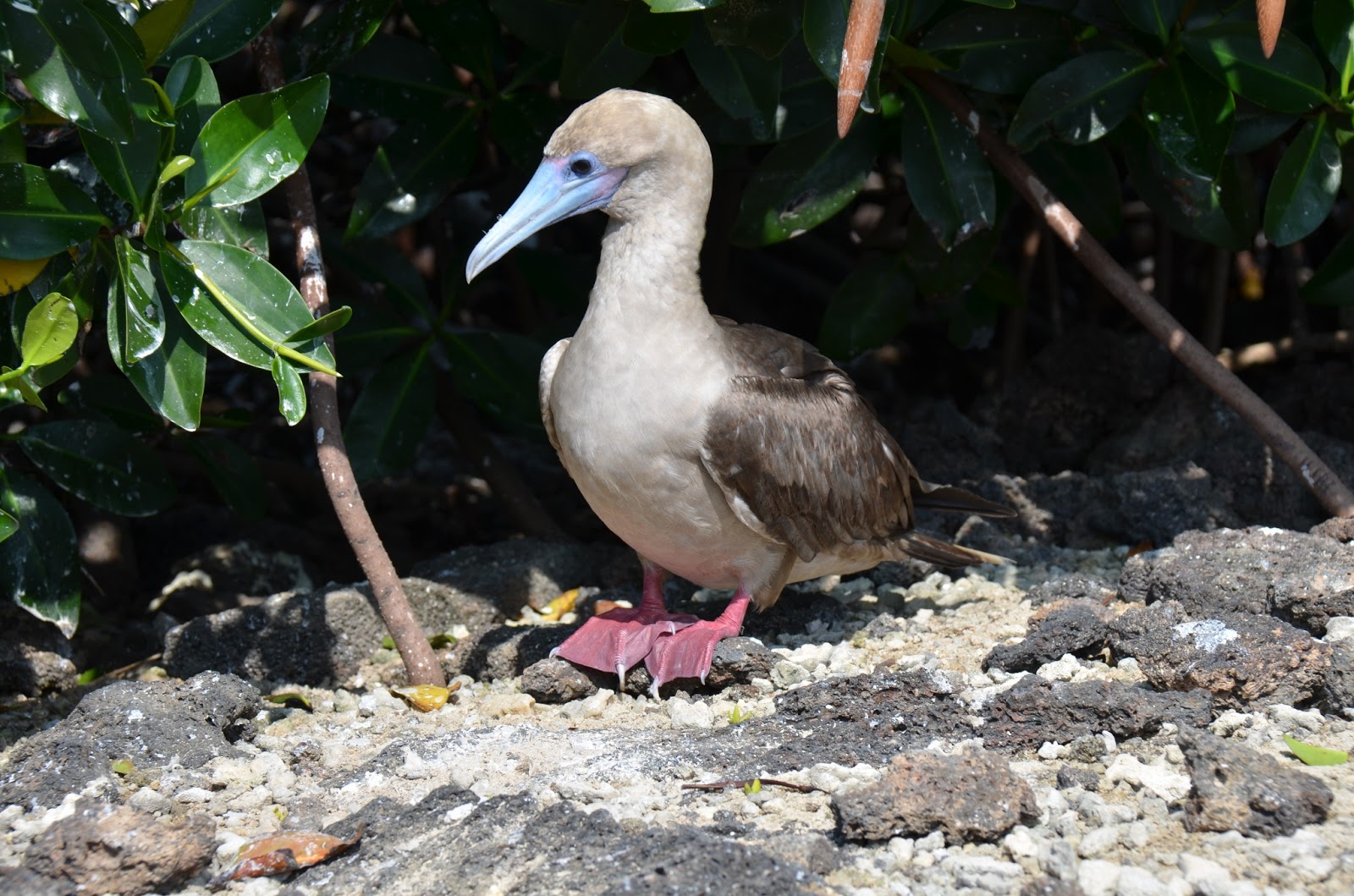
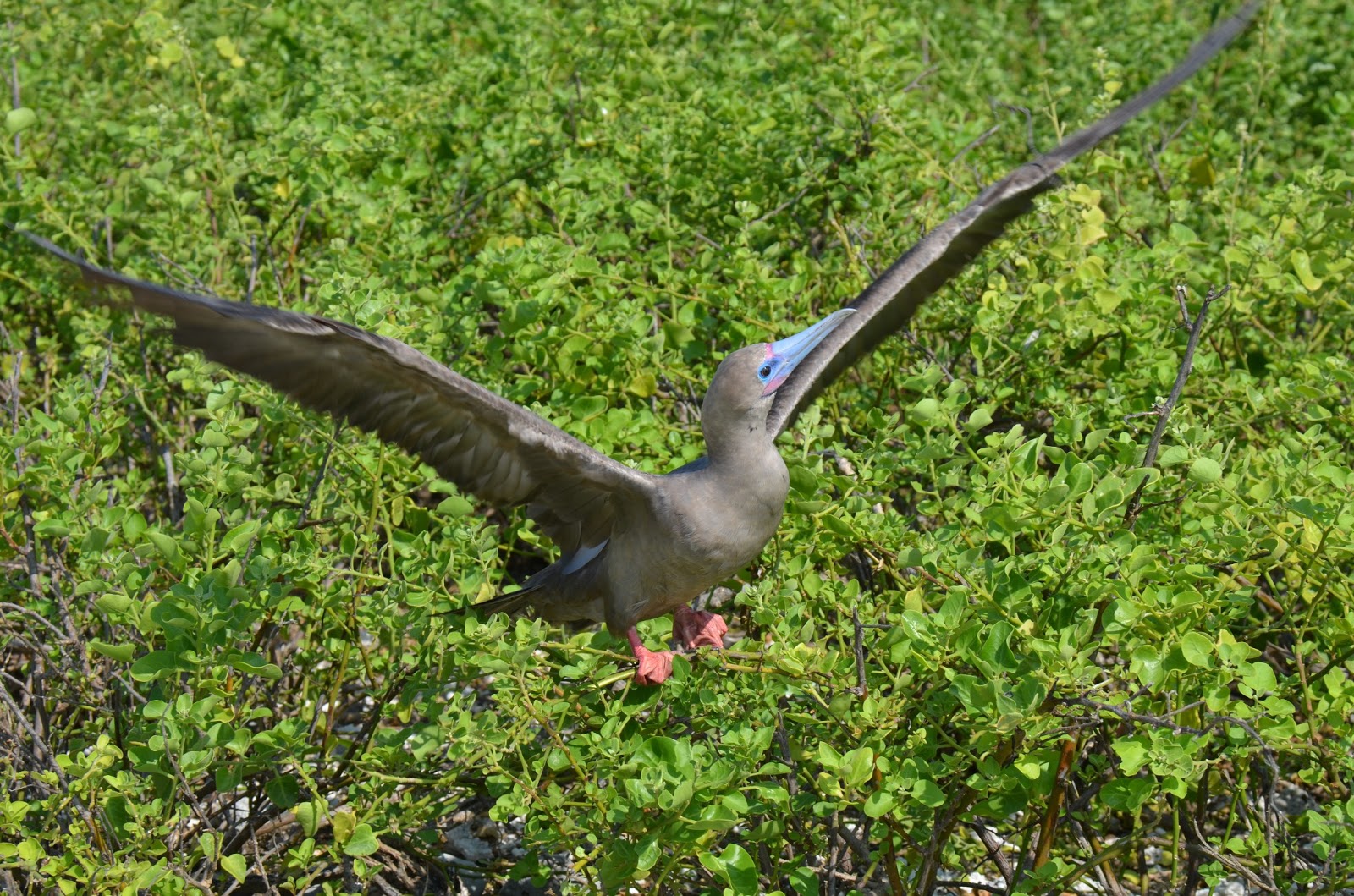
The Galapagos are famous the Blue Footed Booby, a large marine bird with blue feet.  There are actually three types of booby that live in the Galapagos, the blue footed, the red footed and the Nazca.  The rarest form is the Red Footed Booby, and Genovesa Island is one of the few places that they can be seen.  We saw many of them flying and nesting in trees.  We also saw some great examples of Frigate Birds, another large marine bird. The male frigate has a distinctive red throat pouch that it can puff up to make himself appear more attractive to females.

We also saw sea lions up close, including a baby sea lion that was just a couple of weeks old.

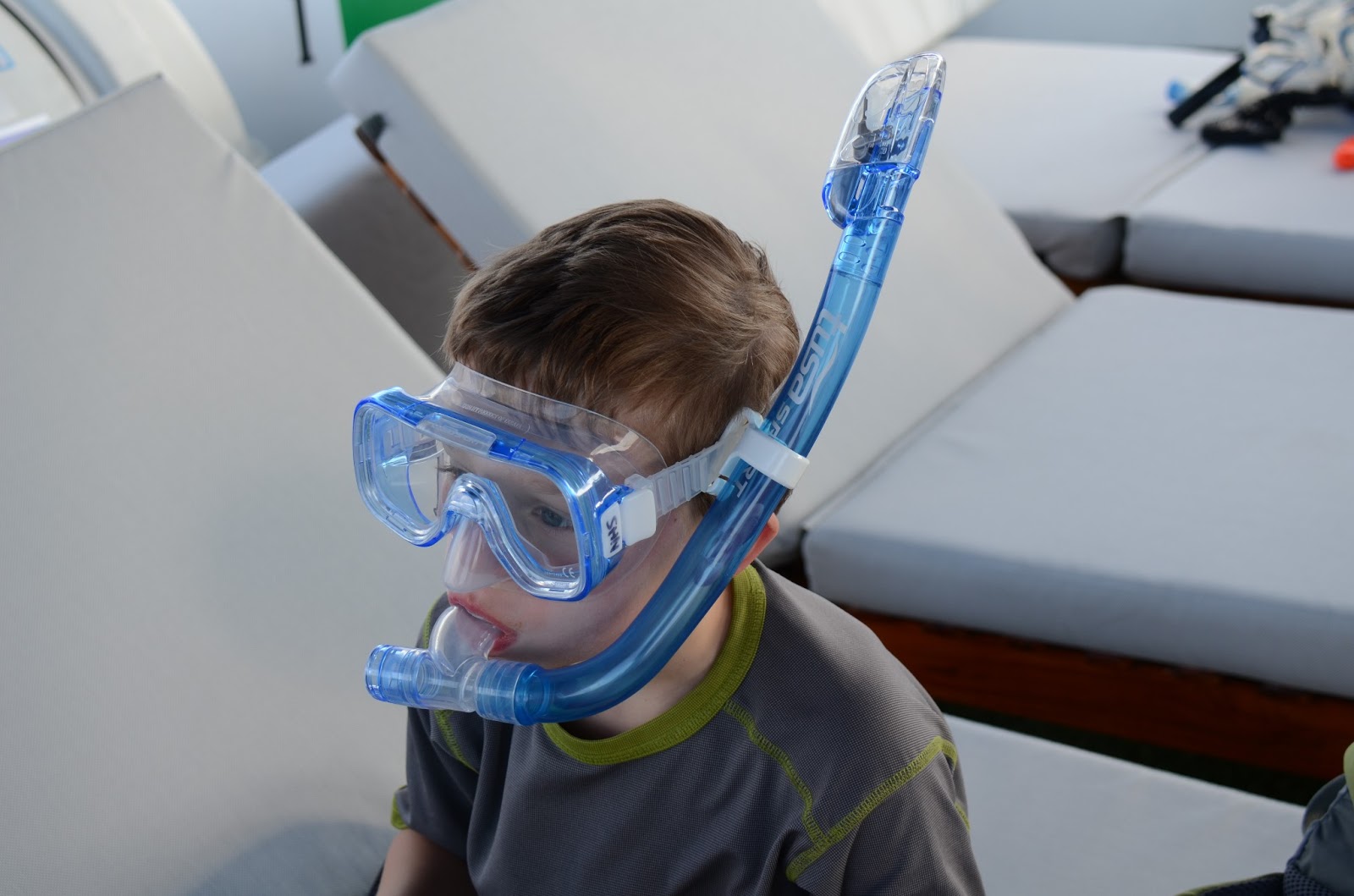
We enjoyed a brief swim and snorkel on the beach before heading back to the boat for lunch.

After lunch, we tried our first “deep water” snorkel.  Deep water snorkeling means that we enter the water in deep water from the pangas, rather than swimming out from the beach.  We spend the afternoon snorkeling along the rock walls of the bay.  The volcanic crater that forms the bay has very steep sides so the fish and other marine life are mostly concentrated along the walls where there is some underwater structure.  Just a few more feet away from the walls and the water depth drops to several hundred feet and in the middle is over 1000 ft deep.

Later we went for a short hike.  We got to the top of the wall via some natural steps and then walked through low trees where we saw many nesting Nazca Boobies and their down-covered young.  The highlight of the evening was seeing several very rare Short-Eared Owls.  We returned to the boat on the pangas as the sun set over the edge of the crater walls.  What a spectacular day in the Galapagos!

Pangas
Our guide Yvonne with Sea Lion
Frigate Bird
Lava Gull
Baby Sea Lion
Beach Snorkeling

Red Footed Booby
Red Footed Booby
Kids with Red Footed Booby
Short-eared Owl

Nazca Booby
Prince Philip's Steps

The Flamingo I
Darwin Bay Sunset

The Galapagos Islands & San Cristobal Island

On Sunday, we arrived in the Galapagos on San Cristobal Island. The Galapagos is an archipelago made up of very young volcanic islands, 5 main islands and many smaller ones.  The islands are contained entirely within the Galapagos National Park and Marine Sanctuary, but it is also a province of Ecuador. San Cristobal is the political capital of the island chain.

After getting settled and having lunch on the Flamingo 1, we went back to shore and spent the afternoon on San Cristobal Island.  Our afternoon tour took us to a tortoise sanctuary where the national park is protecting and raising the famous Galapagos Giant Tortoise.  These huge, slow-moving reptiles are very much endangered.  There are only two places in the world where they live, the Galapagos Islands and the Seychelles Islands off the coast of Africa.  We saw several large adults, and we also got to see the turtle nursery where they are raising baby tortoises.  We saw one bunch of young tortoises that were just a few weeks old.  Giant Tortoises are one of the longest living creatures on earth.  So these young tortoises could still be roaming the Galapagos 140 years from now!

After dinner on the boat, we set sail for our next destination, Darwin Bay on Genovesa Island.


Sea lions at the dock

Our first giant tortoise


San Cristobal Harbor


Sunday, February 17, 2013

Bon Voyage

We made it to the Galapagos! This morning we flew from Quito to San Cristobal Island in the Galapagos. We met the 4 other families who we will be sharing the week with on board the M/V Flamingo, a 20 passenger motor yacht.

We spent the afternoon touring a preserve on San Cristobal Island where they protect and raise the famous Galapagos Giant Tortoise. We saw several of the huge reptiles.

Tonight after dinner onboard the boat, we will set sail for our next island destination.

Internet connections will be slim to none so we will post when we can. Bon voyage!

Saturday, February 16, 2013

Easy Day in Quito


Today we took it easy and had a relaxing day in Quito. While none of us miss the heat and humidity of the rainforest, we are all missing the peacefulness and the sounds of the jungle. 

This morning we went first to El Teleferiqo, a gondola that took us up the side of a nearby volcano, Volcan Pichincha, to an elevation of around 13,500 ft.  It was a clear day and we spent an hour enjoying the vast views of the city below us and the mountains and valleys all around.  When we returned to the bottom of the mountain, we enjoyed a few rides at Vulqano Park, a local amusement park.  After lunch, we spent a little time touring the National Museum where we learned more about the history of Ecuador.

Now we are resting and packing to get ready for an early start on Sunday morning as we head on our way to the Galapagos Islands.  


Friday, February 15, 2013

Our last night in the Amazon


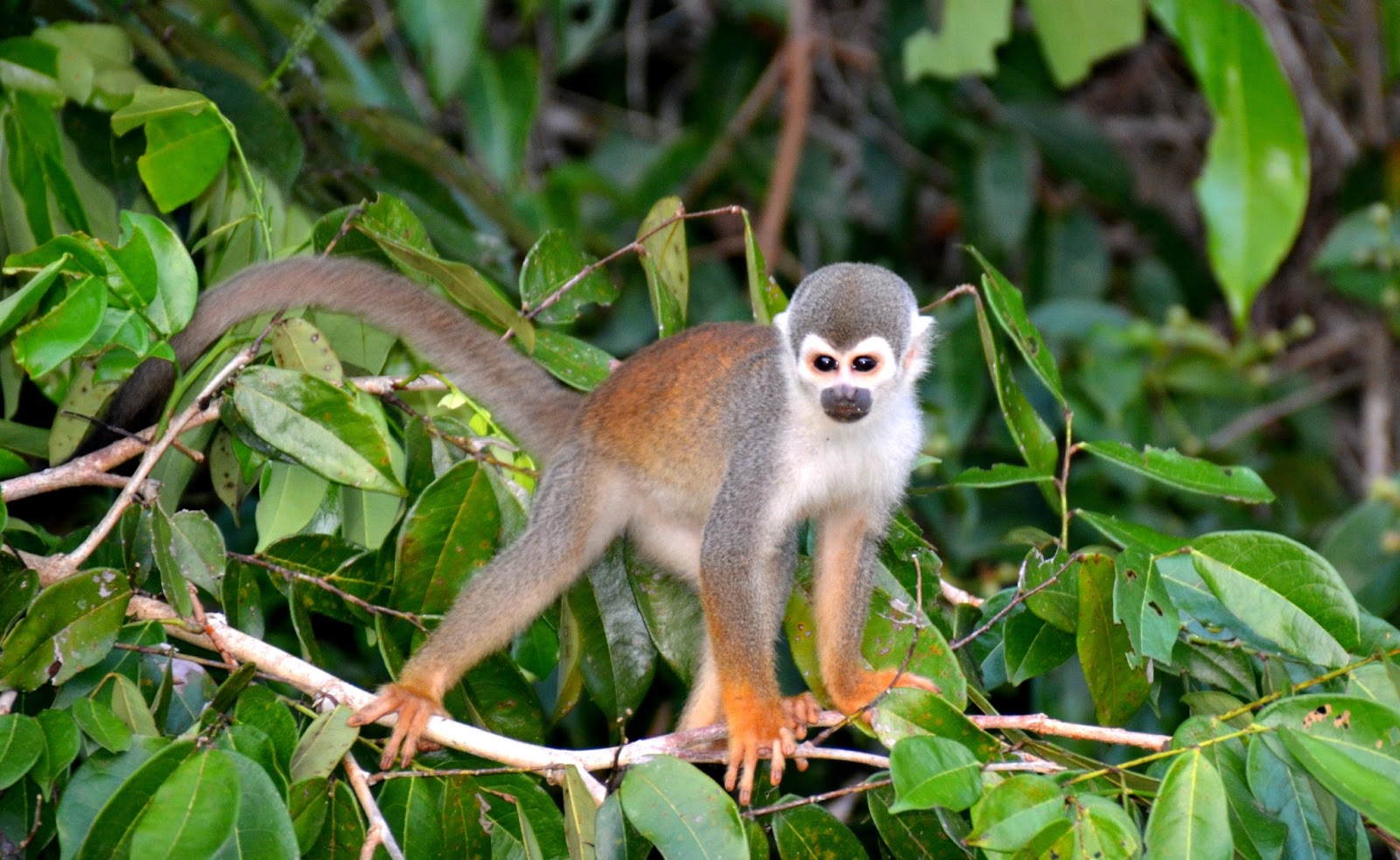
On our final evening, we took an evening canoe ride around the lagoon.  It was a beautiful, calm evening and we saw fish, turtles, birds and monkeys as we slowly glided along.  A nice way to wind down our time in the rain forest.

We loved our stay at La Selva and our experiences in the jungle.  We met great people from all over the world, and we learned a lot.  The jungle is pristine and uncivilized. It is truly a raw and wild place, one of the few on the planet, and because of that it is wonderful, awe inspiring and often breathtaking.  Wow.

On Friday, we return to Quito to regroup, recharge and repack before heading to the Galapagos Islands on Sunday.