Friday, February 15, 2013

Parrots, a Native Village and Weird Food


Happy Valentine’s Day!  Today we traveled up the Napo River a short ways to visit a native village.  Along the way we stopped to view what’s known here as a Parrot Lick, a place where a particular soil that is very high in mineral content is exposed along the riverbank. The minerals are particularly beneficial to parrots, and they gather by the hundreds to lick the soil and absorb the nutrients.

We then visited the village of our native guide, Sergio. We met his mother, who gave us a tour of the village.  The village is fairly modern by local standards.  They have the internet; however, it is contained in one building and the whole village shares it.  They have a relatively large school building, and kids from several neighboring villages attend school here.  Sergio and his mother then showed us some of their gardens and the traditional foodstuffs they grow.

After the tour, they prepared a meal of traditional foods for us to sample.  The meal included fish wrapped in leaves and roasted with palm heart.  We also sampled roasted bananas and plantains, and the roasted seeds from the cacao plant (North’s favorite!).  The adults drank some Chicha, a drink made from a fermented mash of Mantioc root, a local potato-like tuber. Essentially it’s a creamy potato flavored beer.  The real spectacle of the meal though were the roasted Palm Worms. Not really a worm at all, but a large larvae of the Leatherback Beetle, these prehistoric looking grubs are considered a delicacy by the local people. After being roasted on a skewer, they have a slightly crunchy exterior with a soft, chewy center with a slightly nutty flavor. Dad was the only one of us with the stomach to try them, and he lived to tell the tale.

Throughout our jungle visit, not just in the native village, we were able to sample local foods that might be considered unusual in the U.S.A, from exotic fruits to octopus soup.

Parrot Lick

Schoolhouse


The Jungle at Night


Our Wednesday evening excursion was a trip into the jungle at night. That’s right.  We walked into the Amazonian jungle in the dark!  On our way to the trail head the first highlight of the evening was a relatively rare sighting of two Pygmy Marmosets, the smallest monkey in the world.

As dusk settled in, we walked into the jungle along narrow paths and witnessed the amazing diversity of life that only comes out at night.  We saw many strange bugs and spiders, including a huge walking stick bug, a variety of beetle that had phosphorescent eyes that looked like headlights, a nasty looking grasshopper called a Spiny Lobster.  We also saw a couple varieties of bats.


The Sounds of the Jungle


One of the things that we noticed is the incredible sounds of the jungle. It is a noisy place.  At the same time it’s a very quiet and peaceful place.  It’s quiet and peaceful because there is no technology and no motorized equipment.  So you don’t hear any of the hum of modern civilization like the cooling fans on your electronic gear, air conditioners, the relentless dinging of your cell phone, or constant traffic on the street outside. From that sense, it is very, very quiet.  However, without any of those sounds, you quickly become very tuned in to the sounds of nature all around you.  Rain falling high in the canopy of the trees.  The roar of red howler monkeys far in the distance.  The endlessly diverse, crazy, silly and weird sounds of thousands of different insects and hundreds of different birds.  The wildlife, in particular the birds and the bugs, are more diverse than you can imagine and they all make different sounds.  Truly awesome.

A Jungle Walk to the Top of the Trees


Today’s outing started again with a walk along paths on the rainforest floor observing and learning about the amazing plants and animals Amazonia.  But today’s excursion ended with a trip to the top of the trees, a viewing platform 140-ft up above the jungle canopy.   During our walk we saw a lizard, a salamander, and several varieties of frogs and toads: a toad that looks like a leaf, a frog with clear skin such that you could see inside, and two types of poison frog. 

The plant life is even more diverse. We saw a tree that’s leaf is so rough it can be used as sandpaper, and we also saw a tree known as the Walking Palm.  Light can be hard to come by on the jungle floor beneath the thick canopy. The Walking Palm is supported by dozens of separate roots that act as legs. Over time it can put down new roots and “walk” in the direction of the light.

We took a brief break at a small clearing where we got to play Tarzan on a real jungle vine (although our native guides had tied on a handle for us).

Toward the end of our hike, we climbed up a platform that took us into the canopy of the trees 14 stories up.  From there we could watch what goes on high above the jungle floor, primarily the incredible diversity of bird life.  We saw toucans, parrots, falcons and many other colorful and exotic birds.

And when we returned to the lodge, we found a snake right outside our cabana. 


Walking Palm
See the toad?

sandpaper leaf
Tarzan
 
Viewing Platform

View above the canopy


Don't worry, it's not poisonous.

Piranha Fishing


For our Tuesday evening excursion, we took a tour of the lagoon by canoe.  From the water, you have a great vantage point to look into the trees along the water and observe all sorts of bird and animal life.  We saw red howler monkeys way up in the tree tops, and we witnessed a spectacular display of aerobatics put on by a family of squirrel monkeys numbering upwards of 100 animals.  They were traveling along the water’s edge leaping from branch to branch.  It was an amazing site.

The main event for the evening was fishing.  Using a hand line with a hook baited with raw meat, we tried to catch the dreaded piranha.  While we learned that piranha aren’t the aggressive man-eaters portrayed in the movies, they do have razor sharp teeth and must be handled with care.  We caught several piranha in our boat, including an exceptionally large one caught by our guide, and Dad caught a poisonous catfish that has poisonous spikes on its dorsal fin.  Cool.


A Walk in the Jungle


Each day at La Selva, the guests are split into 3 or 4 groups. The groups head out for several daily excursions with two guides to each group, a bilingual naturalist guide and a native guide.  Generally, there is an early morning outing for several hours starting at about 7:00 a.m.  This is the best time of day to see some of the jungle fauna before the heat of midday sets in.  Then we take a long lunch and siesta during the middle of the day and head out for a late afternoon excursion about 4:00 p.m.  Sometimes another short outing after dinner rounds out the daily activities.
  
On Tuesday, our morning outing was a three-hour walk along narrow paths through the rainforest.  Our guides helped us find and interpret all sorts of jungle flora and fauna.  We learned how native jungle inhabitants use some of the plants for medicinal purposes, and we sampled several types of exotic jungle fruit. We saw numerous spiders and insects, including an ant with a fiercely painful bite known as the “bullet” ant, and we saw a poison frog up close and personal.

The highlight of the morning had to be witnessing a family of squirrel monkeys eating and playing in the treetops.  We saw them jumping from branch to branch in the canopy directly over our heads and even saw a mother carrying a baby on her back.


Bullet Ant

Poison Frog

Squirrel Monkey


La Selva, our jungle home


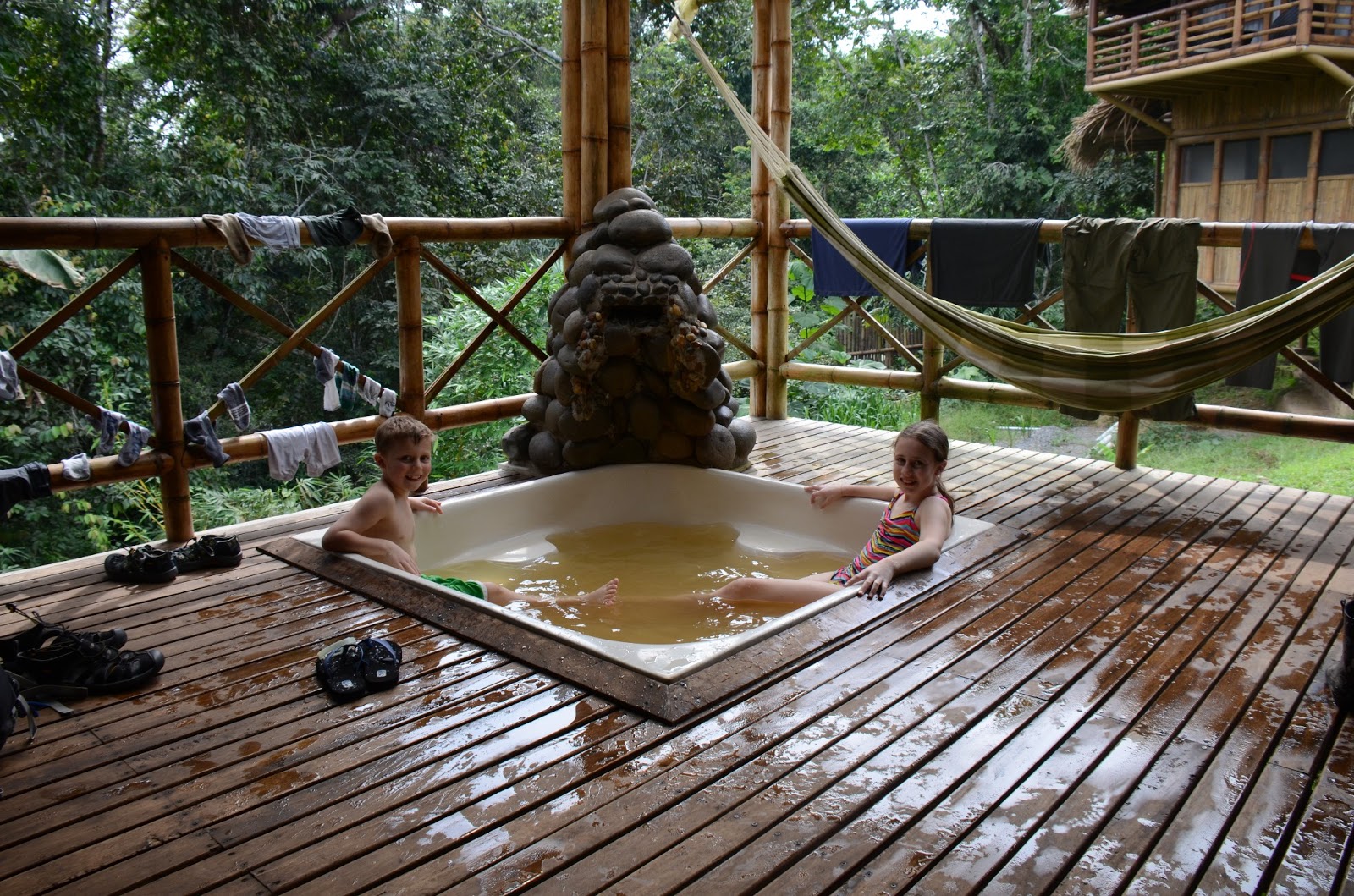
Our home in the jungle is the La Selva Amazon Ecolodge.  It’s made up of a main lodge and dining room and about a dozen separate cabanas separated by beautiful walkways lined with tropical plants and flowers.  Our cabana, constructed of bamboo walls and a thatched roof, is a “family suite” with two bedrooms, a bathroom, and a deck with hammock and an outdoor bathtub.  Yes, we have running water and a flush toilet.  Water comes from a well near the lodge. They say the water is OK to drink, but it has high iron content so it has a reddish color when you fill a basin with it.  We eat our meals in a large, open-air dining room with the rest of the guests.  There are about 25 guests here and they’re from all over the world.  We’ve already met people from Canada, New Zealand, Colombia, England, the Netherlands, and of course our local Ecuadorian hosts.